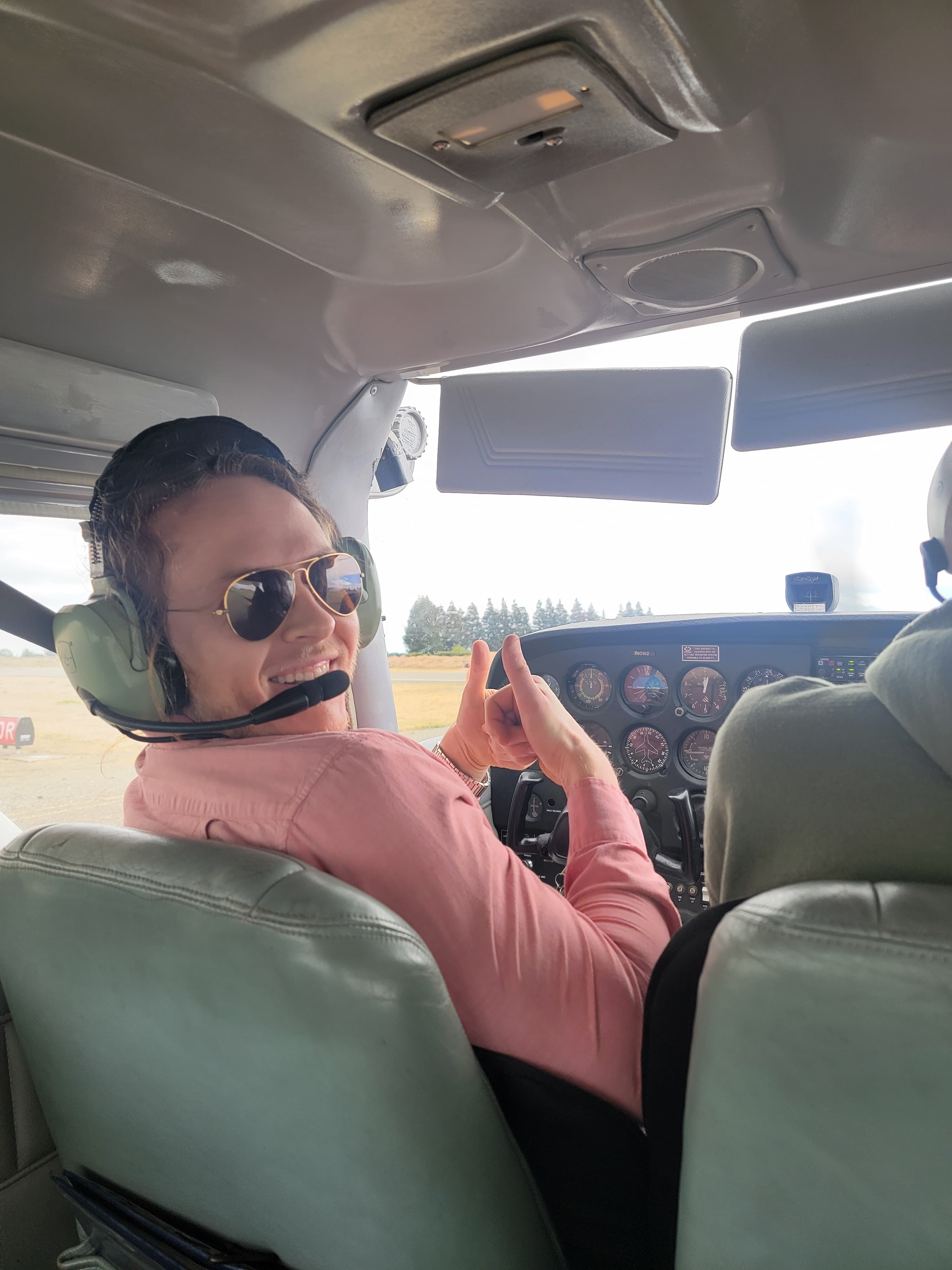
Kyle James DeProw in an airplane cockpit

Hi, I’m Kyle James DeProw, a two-time founding engineer with deep roots in machine learning, robotics, and autonomy. My path runs from mechanical engineering and robotics research at Saint Louis University to applied ML and autonomous aircraft at Boeing. These days I’m CTO at SpineSense and VP of Engineering at AcreAtlas, building software for spinal health and precision agriculture.

Companies

  • SpineSense: tools to help people organize their spine symptoms and medical records, understand them, and prepare for specialist visits.
  • AcreAtlas: drone imagery processing, weed detection, and spot-spray maps for farmers and researchers.

Experience

AcreAtlas · VP of Engineering & Founding Engineer

Building since · Current

I lead engineering for precision-agriculture software that turns drone imagery into weed detections and spray maps for farmers and researchers.

  • Built geospatial image-processing pipelines and adapted NodeODM to stream data to GPUs.
  • Developed plant-anomaly experiments for potato virus Y using frozen DINOv2 features and PatchCore-style scoring.

SpineSense · CTO & Founding Engineer

Building since · Current

I lead engineering across spinal-health assessment, clinical workflows, and imaging, including developing and maintaining the ML components.

  • Built adaptive assessment workflows with deterministic red-flag and urgency screening.
  • Developed MRI segmentation with nnU-Net v2 and geometry workflows for spinal measurements and modeling.

Boeing · Senior Machine Learning Engineer

–

I worked on applied ML for operational monitoring and defensive cyber workflows, taking Behavioral Analysis from a research prototype to a deployed cloud service.

  • Designed, trained, and maintained Bayesian deep-learning models in PyTorch for visual, operational, and navigational telemetry.
  • Built telemetry and investigation workflows using Databricks, PySpark, Azure, and Elasticsearch, with MLflow for model deployment and maintenance.
  • Developed LLM-agent evaluation infrastructure with repeatable tasks, scoring, and trajectory telemetry.

Boeing · Autonomy Engineer

–

I worked on perception and mission planning for autonomous aircraft, developing in simulation and validating the systems in real-world tests.

  • Integrated fused sensor inputs with AI models for aircraft perception and visual tracking.
  • Planned search-and-rescue coverage and tanker rendezvous around flight-time, coverage, and fuel constraints.

Saint Louis University · Robotics and AI Researcher

–

In the CHROME lab, I researched tactile learning and worked on telepresence manipulators and medical devices.

  • Compared LSTMs, neural networks, random forests, and SVMs for recognizing objects from a robotic arm’s tactile and kinematic data.

Dynamic Controls · Control and Automation Engineer

–

Projects

  • SpineSense: a spinal-health platform spanning adaptive assessments, provider workflows, and MRI segmentation. The engineering combines Python/FastAPI services with deterministic screening rules, model routing, and nnU-Net v2 segmentation followed by geometry-based spinal measurements.
  • AcreAtlas: a drone-imagery pipeline for agriculture, from stitching aerial photos to weed detections and geospatial spot-spray maps. I built a GPU-streaming fork of NodeODM and developed potato virus Y plant-anomaly experiments using frozen DINOv2 features and PatchCore-style scoring.
  • Forever Tradecraft: my guilty pleasure—returning to World of Warcraft, a game I hadn’t touched since I was 14, with all the data science skills I’ve picked up in my career… just to make gold. A Lua addon and Python companion turn auction-house scans into a TimescaleDB price history and in-game shopping lists.
  • Palancar: a real-time translation prototype for Even G2 smart glasses. The glasses stream speech to an authenticated Azure relay, which detects the language and sends back English translations with suggested replies. Spanish and Turkish come first.
  • QuantiPy: a financial-market research project that collects price data, news, and Reddit discussions, analyzes sentiment around stock tickers, and stores the results for historical analysis. Python services handle collection and analysis as background jobs.
  • G2 OpenClaw: connects Even G2 glasses to the upstream OpenClaw assistant. A Python WebSocket gateway transcribes speech with faster-whisper, and a TypeScript client talks to the glasses over BLE and streams responses back to their display.
  • CAFA 6 protein function: data loaders, the competition metric, and submission validation for predicting Gene Ontology terms from amino-acid sequences. It’s scaffolding for experiments, not a results write-up.
  • RNN, LSTM, and Transformer from scratch: forward and backward passes written by hand in PyTorch without autograd, trained on Jules Verne and Shakespeare. Based on eduardoleao052’s Transformer-from-scratch.
  • HUE haptic tablet: a 14-inch tablet that combined ultrasonic and electrostatic surface haptics to render textures under a fingertip, built with a Raspberry Pi, an Arduino, and ROS. It was demoed at the 2018 IEEE Haptics Symposium.
  • F-16 trim, linearization, and control: trims a nonlinear F-16 flight model at points in the envelope, linearizes around them, and solves for controller parameters, in Python.

More code on GitHub.

About

Mechanical engineer here who got lost somewhere along the way and ended up in AI and robotics. I got hooked on teaching machines to make sense of the world around them, and I still love applying ML to physical problems. Give me noisy sensor data, a robot, and a reason to connect perception with control, and I’m pretty happy.

I studied mechanical engineering at Southern Illinois University Edwardsville, then did an M.S. in Engineering with a focus on AI at Saint Louis University.

Away from the keyboard, I love hiking, scuba diving, skiing, and a good Brandon Sanderson book. Great food is usually a good reason for a detour.